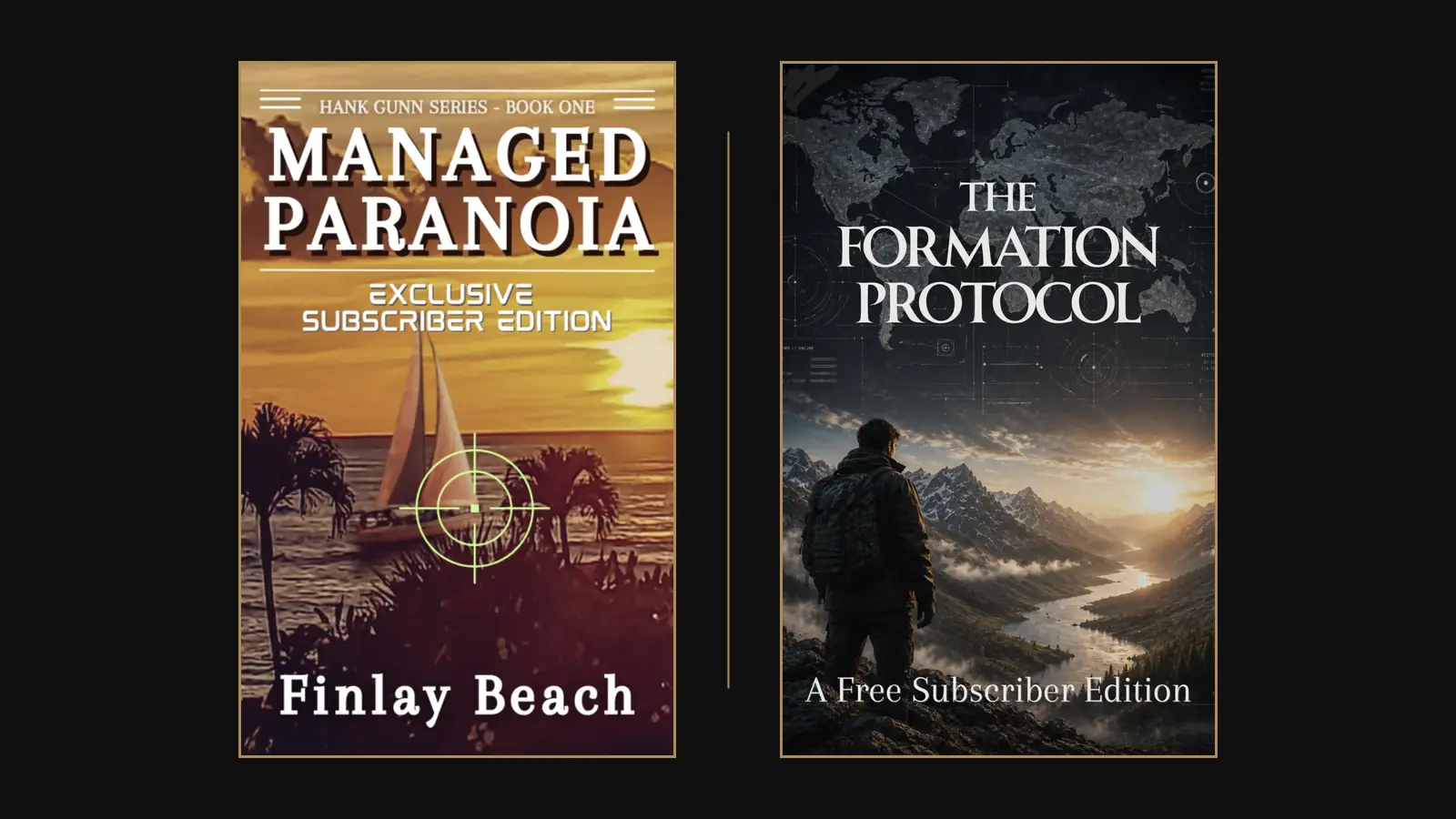
My fiction and nonfiction are separate bodies of work.
Managed Paranoia and Outpost Files tell stories. The Formation Protocol and the seven Formation volumes address formation directly.
The characters do not come from the Formation books, and the Formation books are not explanations of the novels.
But the two sides of my writing share a question.
What becomes visible when pressure arrives?
Fiction lets me place a person inside the moment. Formation lets me step behind that moment and examine what made him able, or unable, to stand.
Pressure Makes Belief Visible
A character can say that he values courage, loyalty or truth.
The story begins when those claims become expensive.
Will he tell the truth when a lie offers safety? Will he remain loyal when loyalty costs him? Will he control fear long enough to act clearly?
Pressure removes the comfort of theory.
Belief becomes choice. Choice produces consequence. Consequence reveals what the person has actually become.
That is one reason I write stories about people under strain. Extremity makes the inner life visible.
The Formation books ask what had to happen before that moment.
A Hero Cannot Be Declared
A writer cannot make a character courageous merely by describing him that way.
The story eventually demands evidence.
He must encounter something that frightens him. He must have an opportunity to escape the cost. He must decide.
The same is true of discipline, competence and conviction. A dependable character has to carry his share of the weight. A capable character has to solve problems. A man of conviction must hold to something when surrender would be easier.
A character who always makes the right choice without struggle is not formed.
He is arranged.
Real people are not formed that way either.
Stories Let Consequences Speak
Fiction should not become a lecture wearing a costume.
A story works differently.
It gives choices room to produce consequences. It lets strength and weakness become visible through action. It allows a reader to feel the pressure before being asked to name the principle beneath it.
That experience matters.
An abstract statement about responsibility can be understood and forgotten. A character’s failure may remain in the reader’s mind because he saw what the failure cost.
A courageous choice can become imaginable before it becomes personal.
Stories do not replace instruction. They prepare different ground.
Formation Names the Work
The Formation books are nonfiction.
They step out of the story and name the capacities directly.
Character. Virtue. Duty. Competence. Preparedness. Conviction. Meaning.
Each volume isolates one field of formation and places thirty concise entries in front of the reader.
No chase. No conspiracy. No fictional danger to hold attention.
Only the idea and the question it raises.
What do you control?
What do you owe?
What must you learn?
What will remain when comfort is removed?
Fiction presents the test. Formation names the training.
Failure Belongs in Both
Formation is not a story of uninterrupted progress.
Young men fail. Adults fail. Characters fail.
The important question is what failure reveals and what happens next.
Does the person construct an excuse or accept correction? Does he become bitter at the consequence or learn from it? Does shame drive him into hiding or does responsibility bring him back to the work?
Failure can become another form of drift.
It can also become instruction.
That is true in fiction because it is true in life.
Worth and Readiness Remain Distinct
A character does not earn his human worth by becoming useful. Neither does a young man reading the Formation books.
Readiness is built.
Keeping those truths together allows stories to take failure seriously without declaring the person worthless. It allows formation to maintain a standard without pretending that achievement creates dignity.
The character matters before he succeeds.
His choices still matter.
That tension gives both fiction and formation their moral weight.
Two Ways Into the Same Question
Some readers enter through story.
They want the danger, uncertainty and consequence. They follow a character into pressure and discover the larger question after the plot has taken hold.
Others want the principle stated directly. They want an idea they can read in seconds, carry into the day and test against their own habits.
Neither path needs to be forced into the other.
The fiction remains fiction. The Formation books remain nonfiction.
One side tells the story.
The other examines the structure beneath it.
Both begin with the same conviction.
No one becomes steady by accident.
Before Pressure Arrives
By the time a fictional crisis arrives, the writer has already been building the character who will face it.
Life is doing the same with us.
The ordinary choices are placing something into the structure. Attention or distraction. Truth or convenience. Discipline or appetite. Responsibility or excuse.
Then pressure arrives and the structure becomes visible.
That is what my stories explore.
That is what the Formation books are meant to help build.
Begin the Work
Join the Formation list and receive the complimentary digital edition of The Formation Protocol, along with occasional Formation notes, new resources and release updates from Finlay Beach.
Formation emails are separate from Finlay Beach fiction emails. You can unsubscribe at any time.