Girls need formation too. My work focuses on boys because young men face a particular problem, and because the kind of men they become will matter far beyond themselves.
That focus is deliberate. It does not mean girls are unimportant or that they do not need discipline, character, competence, conviction or purpose. They do. Others are doing important work there. No worthwhile project has to address everyone, and my concern is boys.
This article is addressed to adults because boys did not create the conditions in which they are growing up. We did. If we have made them dependent, passive and unsure of their own power to act, then we are responsible for returning the work that teaches them otherwise.
The Warning Lights
Young men are losing ground in important areas of life. The statistics are not the argument, but they are warning lights. Among Americans ages 25 to 34, 47 percent of women now hold a bachelor’s degree compared with 37 percent of men. In 1995 the numbers were equal. Pew Research Center has documented the widening education gap. A degree is not the only route to a worthy life, but a widening gap of that size deserves attention.
Bureau of Labor Statistics data also show a long-term decline in male labor-force participation. Among men ages 25 to 34, participation stood at 89.4 percent in 2025 compared with 91.7 percent in 2005. The decline among men ages 20 to 24 was larger.
The warning lights are emotional as well. In the CDC’s 2023 survey of high school students, more than one in four male students reported persistent sadness or hopelessness and nearly one in five reported poor mental health. More than one in seven said they had seriously considered attempting suicide during the previous year.
Anxiety and depression have many causes. That does not release us from naming one that adults are reluctant to face. Too many boys do not believe their actions can meaningfully change their lives. They have little experience of effort producing a result, failure producing knowledge or persistence producing competence. They do not merely lack confidence. They lack evidence.
We can debate every statistic and every cause. What interests me more is the response. The answer has never been to convince boys that they are victims.
The answer is to give them something worth becoming.
We Have Made Boys Powerless
Adults have confused protection with preparation. We solve problems a boy could solve. We step between him and consequences that could teach him. We do useful work he is capable of doing because it is faster, cleaner and easier to do it ourselves. Then we look at the dependence we created and complain that he lacks initiative.
Every unnecessary rescue carries a message. You cannot handle this. Every responsibility withheld says that the work is real but your contribution is not needed. Every consequence removed disconnects choice from result. None of those messages has to be spoken. The structure of his life says them for us.
A sense of control does not come from being told that you are powerful. It comes from discovering that your decisions alter what happens next. Research on youth depression has repeatedly connected symptoms with low levels of perceived control. A boy needs to see the line between his effort and the world. When adults repeatedly break that line on his behalf, dependence is not an accident. It is the lesson.
This is where an internal locus of control begins. Not with the fantasy that he controls everything. He does not. None of us does. It begins with a harder and more useful truth: some things are mine to act upon, my choices matter and I am responsible for the next move available to me.
Small Successes Are Evidence
Small successes are not trophies. They are evidence.
They show a boy that effort can become competence. A meal can be cooked. A wall can be painted. A machine can be understood. A trail can be finished. A frightened animal can be calmed. A younger child can be helped. Money can be earned. Something broken can work again because he stayed with it long enough to learn how.
The success has to be real. Manufactured praise does not build confidence because the boy knows it costs nothing. A trophy for showing up cannot replace the knowledge that he did something today he could not do last month. Encouragement matters, but encouragement is strongest when it names reality.
A boy also needs broad challenges. If every meaningful test comes through the same narrow channel, he may conclude that a weakness in one area is a verdict on his whole life. Put him in contact with tools, land, animals, younger children, older people, difficult books, physical work, paid work, service and the ordinary needs of a household. Give him more than one place to discover that he can become useful. This is one reason the formation of boys has to reach beyond curriculum.
Psychology calls the belief that we can organize our effort and act effectively self-efficacy. The American Psychological Association notes that mastery experiences are a primary source of it. In plain language, a boy begins to believe he can do hard things after he has done some hard things.
He Must Be Allowed to Fall
Success alone is not enough. A boy must also learn what happens when the effort fails.
He must be allowed to fall if he is ever going to learn that he can rise.
Resilience is not a trait adults install with praise. It is the knowledge earned by falling down, getting up, falling again and discovering that another attempt remains possible. A boy learns that embarrassment passes, mistakes can be repaired, strength returns and failure is information rather than a final identity.
When an adult rushes in too early, the immediate problem may disappear. So does the lesson. The boy is spared discomfort but denied the chance to discover what he can survive, correct and overcome. Protection from every fall eventually becomes protection from competence.
This does not mean abandoning him to dangers he cannot understand or consequences that can permanently crush him. Formation is not neglect. Adults choose challenges that stretch without destroying, remain close enough to counsel and refuse to steal the work merely because struggle is painful to watch.
The goal is not a boy who never needs help. The goal is a young man who can distinguish between needing counsel and demanding rescue, who can ask for instruction without surrendering ownership and who understands that a failed attempt is often the first honest step toward mastery.
Screens Fill the Empty Life
Overprotection creates dependence. Dependence leaves a void. Screens fill it.
A screen offers movement without travel, status without service, victory without risk and novelty without creation. The next reward is always close. Swipe, click, level up, receive the message, watch the number rise. The stimulation is real. The substance is thin.
We have reduced fun to a series of dopamine hits and then wondered why slower satisfactions cannot compete. Useful work is often boring before it becomes absorbing. Skill feels clumsy before it becomes satisfying. Relationships require attention before they become deep. A screen can deliver a reward before a boy has had time to become anything.
We detached reward from accomplishment and then wondered why accomplishment stopped feeling rewarding.
The problem is not that every screen is evil or every game is empty. The problem is displacement. When easy stimulation replaces the broad challenges, physical effort, real relationships, useful work and small victories that produce a life, a boy can spend thousands of hours feeling occupied while gaining little command over himself or his world. The U.S. Surgeon General’s advisory on youth and social media warns that more than three hours a day is associated with double the risk of mental health problems including symptoms of depression and anxiety.
Attention is not a minor habit. It is part of agency. A boy who cannot choose where his mind goes will struggle to choose where his life goes. He has to learn to command his attention long enough for effort to compound and genuine interests to form.
What Are We Trying to Produce?
Before arguing about methods, we ought to ask a more basic question: What kind of man are we trying to produce?
My answer begins with capability. A man should know how to do something useful. He should become good enough at something that other people value his work and able to earn a livelihood rather than expecting someone else to permanently provide one.
A productive skill is more than a way to earn a paycheck. It gives a young man some command over his future. He can exchange value for value. He can improve, change course and recover from mistakes. As his competence grows, so does his ability to make choices rather than merely accept the circumstances handed to him.
That capability should reach beyond himself. His family should be stronger because he is part of it. His community should benefit from his presence. He should give more than he takes and be able to carry weight when other people need him.
Become useful. Become capable. Produce something worth having.
That idea runs throughout The Formation Protocol. Formation is not simply about knowing the right things. It is about becoming capable of carrying responsibility when it arrives.
Self-Mastery Must Mature
Self-mastery is often described as restraint. Do not eat too much. Do not lose your temper. Do not waste the day. Those disciplines matter, but they are not the whole of it. The deeper question is whether a boy can supply direction from within when nothing outside him is supplying it.
Can he continue when no one is praising him, the reward is distant and the visible result is poor? Can he work when success cannot yet be imagined? Can he hold to a standard because he has accepted it as his own rather than because an adult is standing over him?
This internal drive gives effort continuity. Without it, a boy is moved by whatever is nearest. Approval directs him. Appetite redirects him. Difficulty stops him. He may appear disciplined while the rewards are immediate and the path is marked, then become helpless when the structure disappears.
But inward direction cannot remain mere stubbornness, self-expression or private ambition. It has to mature. A purpose worth following must survive contact with reality. It has to learn from failure, accept correction and grow large enough to carry duties that are not exciting. Eventually it must become reliable enough for other people to depend upon.
Self-mastery begins when a boy can supply his own direction. It matures when he can preserve that direction through failure, correct himself without surrendering himself and return to the work before success is visible.
This is the internal engine of resilience. He falls, stands, makes sense of what happened and chooses the next act. He may be disappointed without becoming directionless. He may change the plan without abandoning the purpose. He no longer requires life to promise success before he is willing to begin.
Protect and Provide
Those words have become unfashionable, but I see no reason to surrender them. Men should protect and provide.
Both begin with responsibility. Before a boy can carry weight for anyone else, he has to grasp that he is responsible for the part of life placed within his control. His attention. His word. His effort. His appetites. His response to failure. His next decision.
That is not the claim that every outcome is his fault. It is the refusal to hand his agency to circumstance. He may not control what happened, what another person chose or whether the first attempt worked. He still owns the question, What can I do now?
Protection is larger than physical strength. A father protects his family when he exercises good judgment. A husband protects his marriage when he governs his appetites. A businessman protects his employees when he refuses to gamble recklessly with their livelihoods. A man protects his community when he tells the truth even when a lie would be easier. In each case the first contest is inward.
Provision is larger than a paycheck. A man provides knowledge, stability, example and discipline. He teaches what he knows. He prepares his children to become independent of him. He notices what is needed and moves toward it rather than waiting to be managed.
A boy does not learn to protect and provide by being told that someday he should. He learns in smaller forms now. Care for the younger child. Maintain the tool. Finish the job. Tell the truth about the mistake. Replace what was damaged. Save some of what was earned. Notice the person who needs help. Responsibility grows by being carried.
Adults Must Return the Work
If adults created dependence, adults must reverse it.
Stop solving problems he can solve. Stop doing useful work he can do. Stop shielding him from consequences that teach without destroying. Stop treating discomfort as damage and intervention as love.
Give him work with a visible result and standards that are not invented to protect his feelings. Give him decisions whose consequences he will have to manage. Expect repair when he damages something, restitution when he wrongs someone and another attempt when the first one fails.
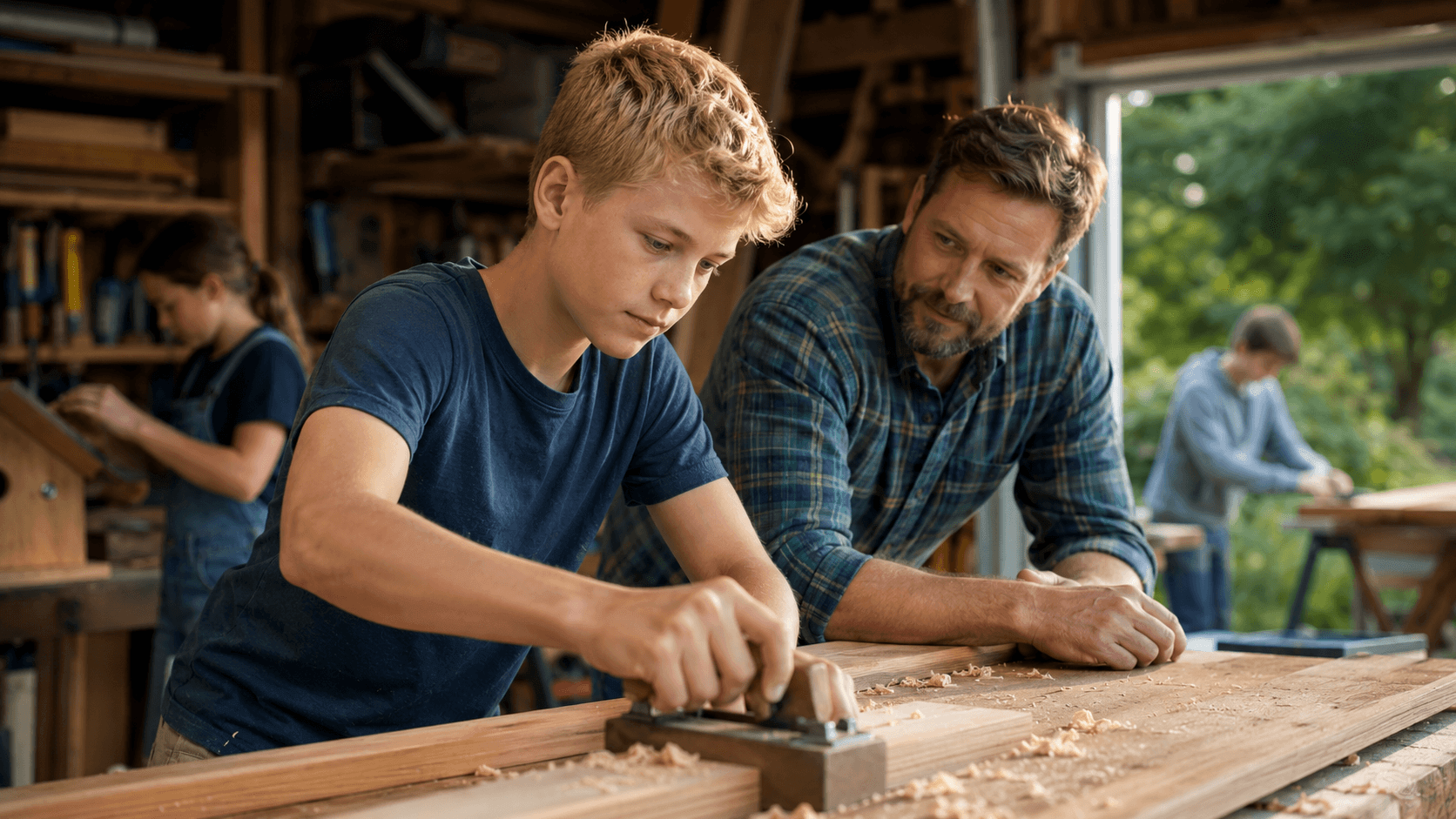
Expand the field of challenge. Let school be one part of life rather than the sole measure of worth. Put tools in his hands. Let him serve people who genuinely need him. Let him earn, build, carry, cook, fix, teach, lead and care for something that can flourish or fail partly because of what he does.
Then resist the urge to seize the task when he is slow, clumsy or frustrated. Counsel him. Demonstrate when necessary. Hold the standard. But leave him enough ownership to say honestly, I did that.
This will be harder for adults than many formation programs are for boys. We will have to tolerate unfinished work, imperfect methods, poor judgment, embarrassment and the possibility that a boy will choose differently than we would. We will have to accept that our efficiency is not the highest good. His growth requires real room to act.
Something Worth Becoming
Boys do not need a painless life. They need a life in which effort matters. They need difficulty they can enter, responsibility they can carry and enough small victories to know that the future is not merely something that happens to them.
They need the experience of acting before confidence arrives, continuing before success is visible and returning after failure. That is how perceived control becomes real agency, how agency becomes competence and how competence becomes responsibility.
Formation does not promise that every boy will win, that every wound will heal quickly or that effort guarantees the outcome he wanted. It teaches something sturdier. His choices have weight. His effort can alter what comes next. He can become the kind of man who governs himself, does useful work and carries responsibility for people beyond himself.
The answer has never been to convince boys that they are victims. The answer is to give them something worth becoming.
Begin the Work
Join the Formation list and receive the complimentary digital edition of The Formation Protocol, along with occasional Formation notes, new resources and release updates from Finlay Beach.
Formation emails are separate from Finlay Beach fiction emails. You can unsubscribe at any time.