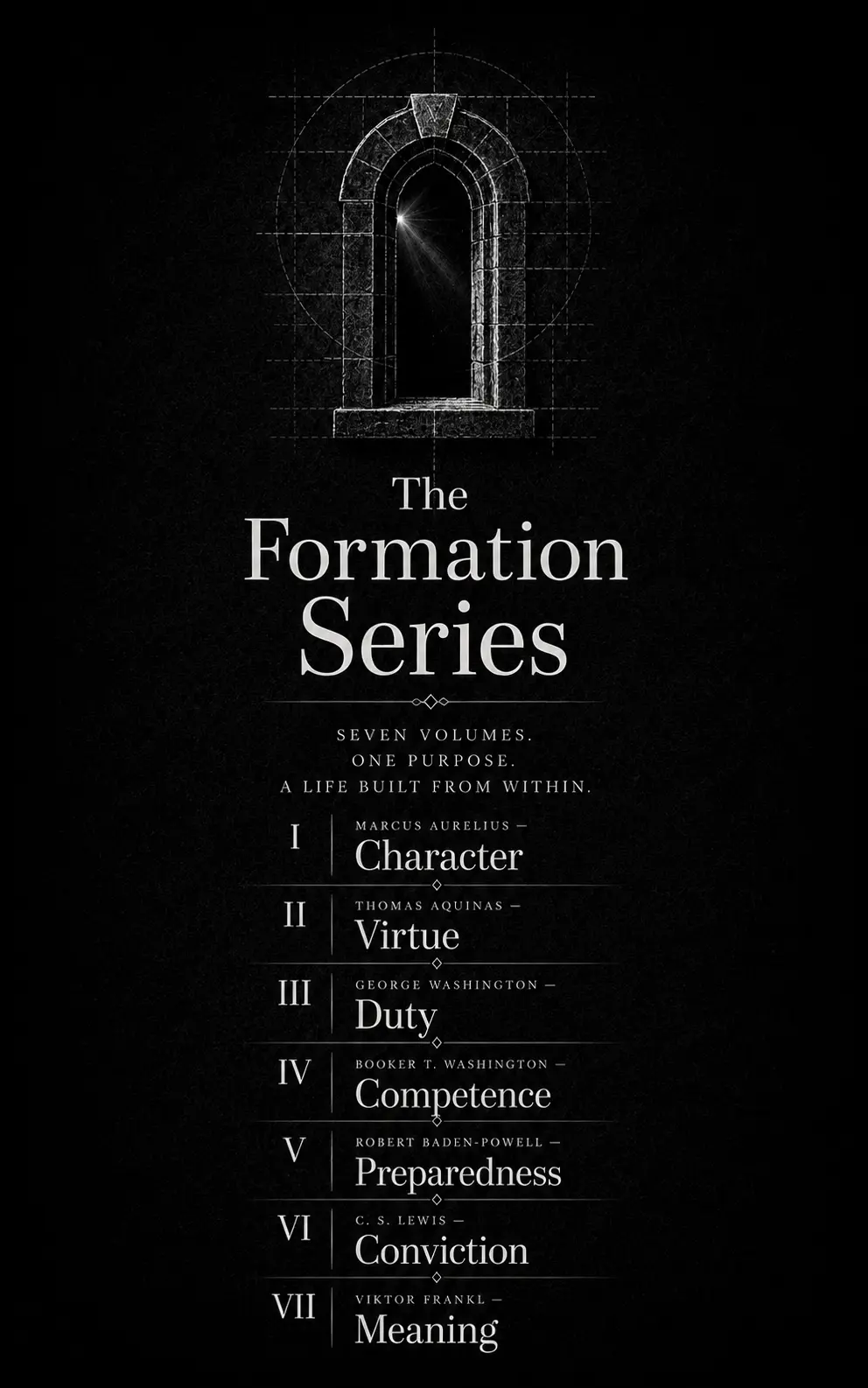
I did not choose the seven men behind the Formation Series because they were perfect.
They were not.
I did not choose them because they agreed with one another on every question or because every part of their lives should be copied.
It should not.
I chose them because each man carried weight and kept enough clarity under it to teach us something worth recovering.
The aim is not hero worship.
It is to think alongside serious men and allow their strongest ideas to sharpen us.
Marcus Aurelius: Govern the Inner Life
Marcus Aurelius held enormous public power while writing privately about the government of himself.
He returned repeatedly to attention, restraint, duty and the need to separate what is within our control from what is not.
That distinction remains essential.
A man who cannot govern his response will eventually be governed by events, appetites or other people. He may possess freedom in law while lacking it within himself.
Marcus helps begin the series with character because the first field of responsibility is the inner life.
Not the world as we wish it to be.
The response that is ours to command.
Thomas Aquinas: Align Reason With Truth
Thomas Aquinas refused the false choice between faith and reason.
He treated truth as something to be sought, understood and lived under. Reason was not a weapon for escaping moral order. It was a faculty meant to recognize it.
Virtue, in this view, is more than good intention. It is the formation of habits ordered toward what is truly good.
A young man needs more than sincerity. He needs a standard beyond preference and the ability to reason toward it.
Aquinas helps establish that moral formation is not blind obedience or self-invention.
It is the disciplined alignment of the mind, will and life with truth.
George Washington: Restrain Power With Duty
George Washington understood that leadership is revealed as much by what a man refuses to take as by what he achieves.
Power always offers excuses for excess. Ambition can disguise itself as service. Authority can begin serving the person who holds it.
Washington’s example is useful because he repeatedly placed restraint beside duty.
Leadership is not permission to indulge the self on a larger stage. It is an obligation to carry responsibility without becoming owned by position.
The Formation of Duty asks what remains when applause, advantage and personal desire are removed.
Duty outlives mood.
Service outlives recognition.
Booker T. Washington: Build Through Useful Work
Booker T. Washington treated competence as a form of strength that could not be taken away easily.
He emphasized disciplined work, practical skill, self-reliance and the dignity of becoming useful.
This is not a small vision.
The ability to solve problems, produce value and complete necessary work creates real independence. It turns potential into capacity.
A young man should not be taught to look down on useful work while waiting for important work to arrive.
Useful work is where importance often begins.
Booker T. Washington helps the series move from good intention to trained ability.
Robert Baden-Powell: Prepare Through Repeated Action
Preparedness is often misunderstood as equipment, contingency plans or a taste for adventure.
Robert Baden-Powell understood it more broadly.
Readiness is built through repeated action. Observation. Service. Skill. Endurance. The habit of noticing what needs to be done and becoming capable of doing it.
Preparation begins before the emergency announces itself.
The prepared man does not become dramatic when difficulty arrives. He carries what has been placed before him steadily.
Baden-Powell helps turn readiness from an idea into a practice.
C. S. Lewis: Recognize Truth Beyond Fashion
C. S. Lewis wrote in a time increasingly suspicious of objective moral truth.
He understood what is lost when feeling becomes the final authority and every standard is reduced to preference.
Conviction requires more than intensity. A person can feel strongly and still be wrong.
Lewis brought imagination and reason together in defense of truths that do not change because the culture has changed its language.
He helps ask whether belief is merely inherited, socially convenient or actually grounded.
Conviction should be able to survive examination.
Viktor Frankl: Answer Life With Responsibility
Viktor Frankl wrote with the authority of suffering endured rather than suffering imagined.
He did not pretend that pain is good or that every loss can be explained. He insisted that suffering does not erase the human responsibility to answer life.
Meaning is not automatic.
It is discovered through responsibility, love, work and the stance a person takes toward what cannot be changed.
Frankl closes the series because the question of meaning gathers the others together.
What is character for? Why practice virtue? Why accept duty, build competence, prepare and hold conviction?
Because a life must answer something larger than comfort.
Seven Guides, One Standard
These men came from different centuries, circumstances and traditions. Their presence together is not a claim that their beliefs were identical.
It is not canonization.
Each offers a lens through which one part of formation becomes easier to examine.
Marcus Aurelius helps us consider character. Aquinas clarifies virtue. Washington demonstrates duty. Booker T. Washington grounds competence in work. Baden-Powell makes preparedness active. Lewis defends conviction. Frankl confronts meaning.
The seven men are useful guides.
They are not the foundation.
I follow Jesus Christ. He remains the standard beneath this work. The value of these historical thinkers is that their lives and ideas can help illuminate truths about responsibility, discipline, conscience and life under authority higher than ourselves.
We do not have to imitate them completely to learn from them honestly.
Think Alongside Them
The Formation Series invites the reader into a conversation across time.
Not to live in the past.
To recover what the present is in danger of forgetting.
Self-command. Truth. Duty. Useful work. Preparedness. Conviction. Meaning.
Different questions, but one work.
The formation of a person capable of carrying freedom and responsibility together.
Explore all seven Formation books.
Begin the Work
Join the Formation list and receive the complimentary digital edition of The Formation Protocol, along with occasional Formation notes, new resources and release updates from Finlay Beach.
Formation emails are separate from Finlay Beach fiction emails. You can unsubscribe at any time.