Hank at Seven
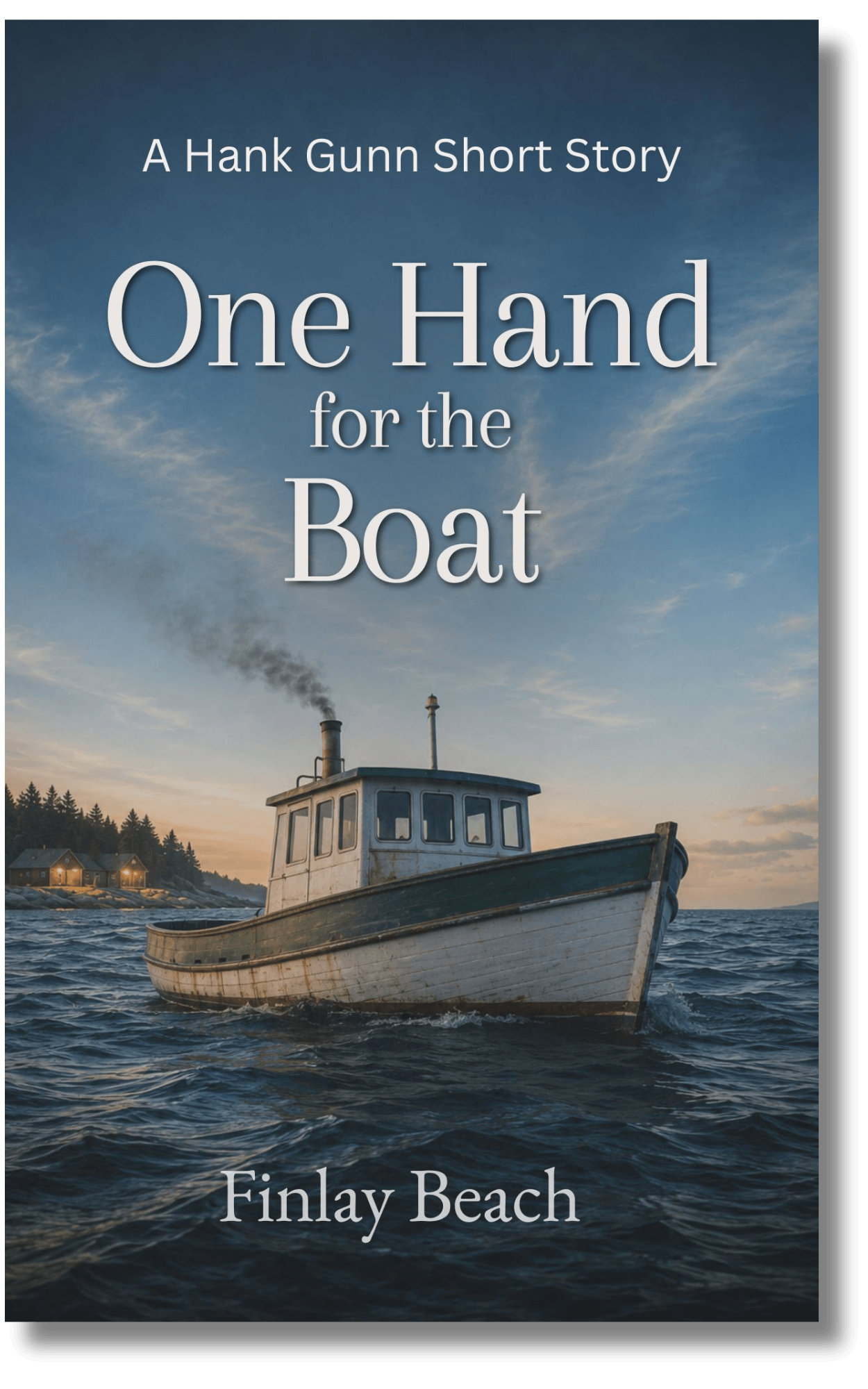
One Hand for the Boat
A Hank Gunn Short Story
by Finlay Beach
“Matthew, are you bringing that child to bed or turning him into a night owl?”
Anne’s voice crackled through the shop intercom.
“Hank has Zach’s birthday party tomorrow,” she said. “If he plans on going, he needs sleep. It’s already late.”
Matthew Gunn looked toward the microphone nailed to the wall near the workbench. He answered like a man hailing another boat across a harbor.
“Honey, I just finished the berth. It’s all set up for Hank to spend the night. We’ll finish this watch early, and he’ll be dreaming of fair winds before six bells.”
“What’s six bells in English, skipper?”
Matthew glanced at the clock.
“How does eleven sound?”
“Pretty late.”
“Barely dark by sailor standards.”
“Just make sure your bedtime stories aren’t the kind that give him nightmares.”
Matthew looked down at his son.
Hank was almost seven, dark-eyed and solemn when he wanted to be. He had one hand wrapped around the tiller of a boat that had not yet touched water and the other raised in a triumphant thumbs-up.
Matthew tried not to laugh.
They had been caught.
Before the intercom interrupted, his story had involved a schooner under too much canvas in a rising gale, reefs tied hard into soaked sailcloth while the Atlantic came up black and mean around her. It was not the sort of thing Anne considered restful.
Matthew considered it education.
There was never a shortage of stories. Most came from old captains, old harbors and old boats that had carried too much sail because speed meant money and hesitation meant ruin. Clippers. Schooners. Fishing boats. Rumrunners. Tired working craft that had seen more weather than paint.
Matthew gave them all voices. He gave the sea a temper. He gave every captain a decision that had to be made before dawn.
The brave crews usually made it home.
Usually.
“It’s clear sailing from here on out,” Matthew said toward the intercom.
Anne did not sound convinced. “I’ll be down to check on you two in an hour.”
Matthew smiled. He knew she would be asleep on the couch long before then, one of her hospital novels folded open on her chest.
“Good night, honey.”
“Good night, boys. Happy sailing.”
The intercom clicked off.
For the next hour, Matthew and Hank sanded the coaming by hand. It was not the fastest way, but it suited the night. Sanding kept the shop quiet. It gave Matthew room to talk and Hank room to listen. It also gave a craftsman the kind of control machines liked to steal.
The boat in the shop was a beauty. A long, canoe-sterned wooden sailboat built from a Herreshoff design, all sweep and restraint. Matthew had spent more than a year shaping her. His attention to detail had won him the contract. His hands could build a boat with the precision other men saved for fine furniture. That skill mattered when the lobster catch was poor and the taxes were not.
The Gunn homestead had held its place on the Maine coast for five generations. Three hundred feet of shoreline. Old acreage sloping toward cold water. A house that had endured storms, grief, babies, funerals and men who came home smelling of diesel, bait and salt.
Matthew and Anne were trying to hold it long enough for a sixth generation.
That generation was currently wearing sawdust in his hair and pretending he knew how to inspect a berth.
Hank had an official job in every boat his father built. He was responsible for making sure it slept right.
“If a boat doesn’t sleep right,” Matthew had told him many times, “I’ll have to shove her off, burn her to the waterline and start all over again. A craftsman has a reputation to uphold.”
So far, Hank had never found a boat that failed the test.
Tonight he had a real berth. Narrow, plain and perfect.
Wrapped in a sleeping bag covered with Ninja Turtles, Hank studied the new boat’s interior. Even in low light he could see the pale sweep of yellow pine and the clean curves his father had made by hand.
Matthew leaned around the corner.
“Boo.”
Hank giggled and pulled the sleeping bag to his chin.
Matthew added a wool blanket, tucked it tight around his son and brushed a curl away from his forehead with a hand rough enough to sand oak and gentle enough to settle a child.
Hank was glad he was not too old for a kiss goodnight.
“Sleep tight,” Matthew said. “Don’t let the bedbugs lay eggs in your ears.”
“Dad. That’s not how it goes.”
“It isn’t?”
“It’s don’t let the bedbugs bite.”
Matthew frowned as if considering the matter. “I like mine better.”
“You always say that.”
“You know what else I always say?”
Hank smiled into the blanket. “You love me.”
“That’s right. Don’t forget it.”
“I won’t.”
“You got that unidentifiable brown one-eyed stuffed thing in there?”
“His name is Zoogo.”
“Right. Zoogo.”
“Z-o-o-o-o-o-o-g-o.”
The number of o’s changed depending on Hank’s mood. Tonight there were many.
Zoogo had once been a koala. Since Hank was a baby, the animal had never missed a night beside him. One eye remained. The nose was rubbed flat. One ear had gone soft and thin from years of being worried between small fingers.
To Matthew, the toy looked like something that should have been retired with honors.
To Hank, Zoogo was priceless.
“You and Zoooooogo get some sleep,” Matthew said.
“Okay.”
“Good night, Hank.”
“Good night, Dad.”
Hank pulled the blanket up over his face and pressed his nose into the old stuffed animal. The sharp bite of yellow pine filled the cabin. It was strong enough to sting.
Outside the berth, his father went back to sanding.
The radio played softly. Classical music suited the boat. Matthew kept sanding until he was sure Hank was asleep. Then he climbed down, threw scrap wood into the stove and crossed the yard to the house under a hard Maine sky.
Anne was on the couch, just as he expected. Her book lay open across her face like a little paper roof.
Matthew lifted the book away, marked her place, turned off the lamp and helped her to her feet. She moved like a sleepwalker, murmuring something about the door still being open.
“It’s all right,” he whispered.
By the time her head touched the pillow, she was gone again.
Matthew stood there a moment.
They did not talk much about the marriage. Neither of them thought it was broken. Neither thought it was thriving. Work took the days. Hank took the heart of what was left. The house took the rest.
Anne was morning. Matthew was night.
Once, that had seemed charming. Lately it felt like tide running against tide.
He brushed a strand of auburn hair from her face and kissed her forehead. Then he went back to the shop.
The boat waited beneath the lights.
Matthew could have been content to keep her there forever, tucked inside the smell of pine, varnish, dust and heated iron. A man could grow attached to a boat while building her. That was the danger. First came measurements, fasteners and money. Then came shape. Then came feeling.
Captain Tom had warned him about that once.
“The trouble with your work, Matthew, is that I start feeling guilty when I take delivery.”
“The guilt will pass once you start showing her off.”
“That’s what happened with Spark.”
Spark had been Tom’s trimaran. Lean, fast and wrong-looking to half the old men along the coast. Tom had come back because Matthew understood that even a strange boat needed a soul.
“So why the new boat?” Matthew asked.
“I’m shipping Spark to the other side of the world. She’s just the boat for the kind of mischief I have planned after I retire from the Navy. But when I’m around here, I want something older in spirit. A true New England classic.”
Matthew knew better than to pry. He gave the conversation the necessary turn.
“Classic means expensive when said by a man with an eagle on his collar.”
Tom reached into his jacket and handed Matthew fifty one-hundred-dollar bills.
“Then give me something worth feeling guilty about.”
Matthew took the deposit and began building the hull in his head before Tom reached the end of the driveway.
Now the boat was nearly finished.
The final payment would matter. A ring Anne had admired in Portsmouth. A rebuilt engine for Maggie May. Some left over, maybe, for the coffee can on the shelf beside the bronze screws.
Inside that can was a private collection of twenties, fifties, hundreds and three gold doubloons Matthew had bought from a man who needed cash more than history.
He did not know what the can was for yet.
Someday, he would.
He worked until his arms cramped and his back tightened. When he finally stood in the cockpit and stretched, the clock read quarter to four.
He pushed the tarp aside and looked into the cabin.
Hank was still asleep, one cheek pressed against Zoogo, one hand outside the blanket as if he had been reaching for something in a dream.
Matthew smiled and let the tarp fall back into place.
***
Outside, May had not fully convinced Maine to let go of winter. Frost glittered across the hood of his pickup. The stars hung hard and clear in a moonless sky. Not a breath of wind moved over the yard.
A calm morning was a good time to move a few traps before the season thickened.
Matthew found a notepad in the kitchen drawer and ignored the drug company logo printed across the top.
He wrote carefully.
Anne,
Took off to tend traps and set a few. Should be back by 11 to get some sleep. Hank is snug in the boat. He’ll probably sleep till I get back.
Love,
Matthew
He left the note beside the phone.
A skin of frost had formed on the corner of the windshield. The truck engine turned over at once. Heat blasted from the vents. Country music exploded from the speakers.
Matthew flinched and stabbed the power button.
At the road, he turned toward town.
He was surprised by the traffic. Too many headlights for that hour. People who called him neighbor now drove two hours to jobs somewhere else, then drove home and pretended they still lived in a fishing town.
At the wharf, a few dim lights burned aboard boats whose owners had the same idea.
Maggie May waited in the slip his grandfather had used and his father after him. She had been his father’s boat before she became his.
The slip beside her sat empty.
That one belonged to Matthew’s brother, Sidney Alden Gunn.
Sid to everybody except their father, who used the full name whenever disappointment entered the room.
The old man had never forgiven Sid for leaving after high school. Sid had found a good job, married a pleasant woman and raised two daughters, but none of that mattered. The oldest Gunn boy had been expected to fill his father’s boots. Instead, he had walked away from the boat, the wharf and the name.
Sid returned for the funeral, then left before the will was read.
The house, the land and the working gear went to Matthew and Bob.
Everything except the slip.
Their father had willed Sid one thing. A guaranteed hole in the water where a commercial lobsterboat fit perfectly.
Sid paid the fees every year and kept it vacant.
Matthew understood why, which made looking at it worse. He took his eyes off the empty slip while Maggie May eased out from the dock.
He pushed the thought aside and accelerated out of the harbor.
***
The morning work steadied him.
He found lobstering meditative in a way boatbuilding never was. Building boats demanded judgment. Every curve, joint and fastening raised a question that had to be answered correctly. Lobstering was more honest. Weather, tide, gear, bottom. The work could be hard, but it was rarely mysterious.
Maggie May was typical of the Maine working boats of her generation. High bow, strong flare forward, low stern, flat bottom for speed and a tired diesel that smoked more than Matthew liked. Her small wheelhouse gave shelter. Aft, the open deck gave him room to stack traps. On the starboard side, a heavy support arm carried the open pulley that made hauling possible.
By midmorning the breeze had lifted. The water took on its familiar chop. Matthew had three traps left to move and a fourth heading for the bottom when he slipped.
It was not unusual.
Men slipped on working boats. Water, slime, rope, bait, gear, seaweed, a misplaced lobster, a half-second of inattention. Most times a man landed hard, cursed, looked around to make sure no one saw him, then got back to work.
Matthew did not know how he went over.
One moment he was on deck. The next, the cold hit him.
It ran inside his gloves, up his sleeves, down into his foul-weather gear and through every layer beneath. His boots filled, then dragged. His body seized so hard he could not tell if he was breathing.
By mercy or luck, his head stayed dry. His wool cap held.
His right hand found the boat.
Only his fingertips caught one of the narrow horizontal guards mounted along the hull. He clamped down and held.
The trap line hung taut from the pulley inches from his face. It led sharply into the water. It appeared fouled somewhere aboard.
That could save him.
He tugged it.
No give.
The trap had not reached bottom. Its weight was still on the line.
The cold had not yet stolen his strength. That was good. He had time if he used it well.
He considered working his way aft to the stern. There was a narrow lip near the waterline. If he could reach it, he might get a foot on it, grab the toerail and clamber back aboard.
But the line was right there.
Secure. Familiar.
His boots were already gone. Good.
He set both stocking feet against the wooden guard and grabbed the rope as high as he could. The gloves held. The line held.
He pulled.
His soaked body rose out of the water. Ankles first, then knees, then hips. He got his waist almost level with the rail. The cold water streamed from him in sheets.
For one bright second, he thought he had it.
Then he saw the problem.
The rail was too low. The deck was too far in. His body leaned away from the boat. He could not simply roll in.
He held there, breathing hard, his legs trembling against the hull.
The pulley was just above him, but reaching it would be risky. If it swung or rolled, it could drop him back into the water. The stern route was still possible, but lowering himself back down felt like surrendering hard-won height.
He studied the deck.
A dive across the narrow quarter. One hard push from the line. Grab the coaming. Let his legs follow.
It could work.
It had to work the first time.
His forearms shook.
He could hear his father’s voice.
One hand for the boat, one hand for yourself.
Matthew pressed his stocking feet harder against the guard, shifted his weight and pushed away with his right hand.
Good.
Closer.
He reached toward the deck and missed by inches. He caught the line again.
His body swung back.
The boat rose on a short wave and dropped.
He waited. Reset. Breathed.
All preparations had been made. The height was there. The distance had closed. The decision had been made.
He drove down on the line with everything his left arm had left.
The bind let go.
The rope tore through the pulley.
The trap took it.
Matthew went down with it.
His hand locked around the descending line. He demanded that it open. It would not. Then it did.
But it cost him.
The cold closed over his head.
Time changed.
The surface was above him. Close, then not close. Bright, then broken. His arms moved badly. His lungs burned. His body wanted air, but his mind wanted the boat. The boat was life. The boat was home. The boat was the world.
He broke through and sucked in a ragged breath.
The buoy floated nearby, painted in his colors, as if nothing of importance had happened.
Maggie May was ten feet away.
No.
Fifteen.
How had she gone so far?
He yelled when he saw the white cabin cruiser.
“Help! Stop!”
Even as the words left him, he understood they would do no good. The boat cut past less than a hundred feet away, engines throbbing, wake piling high behind her. On the stern, friendly lettering spelled Misty.
No one looked back.
Her wake reached him before he was ready. It lifted him, turned him and gave him a mouthful of salt water.
He coughed, rolled and looked for Maggie May again.
She was farther off.
No. Not farther. He was slower.
He stripped off his overcoat, fighting the dead weight of it. The water had pushed deep into him now. His hands were clumsy. His body felt both heavy and strangely hollow.
He rolled onto his back and began to swim.
Slow was fine. Steady was better.
“Steady as she goes,” he said.
Or thought.
He could not tell.
After a dozen strokes, he rolled to check his distance. The boat was still there. White hull. Dark green topsides. Engine idling. Smoke rising from the stack.
He was closing.
Good.
He turned back over and kicked again.
Zach’s birthday party came into his mind.
Not as a thought. As a room. Bowling alley smoke from the night before. Children shouting. Hank laughing. Anne checking the time.
The note on the counter.
Should be back by eleven.
He always added an hour. Sometimes two.
She would not worry until noon.
He laughed once, but the sound came out wrong.
His head bumped the hull.
He had made it.
He turned toward the boat, placing one hand on the waterline lip that wrapped around the stern.
The old engine still idled. Oily smoke curled along the deck and drifted into the clean spring air.
The sky above him was blue.
So blue it seemed impossible.
Maine was a fine place to live when it was nice. No one ever told the truth about that. They talked about cold, taxes, storms and bad roads. But when Maine was beautiful, it was beautiful enough to make a man forget the rest.
He wished Anne and Hank could see the sky.
He wished he had stayed in the shop.
He wished he had shut the radio off before it hurt his ears.
He wished Sid would use the slip.
One hand for the boat.
The words came again.
Matthew looked at his hand on the stern lip. It seemed to belong to someone else.
“One hand for the boat,” he said.
Then, for a reason that made sense only in the bright ruin of his mind, he let go.
The boat moved away.
Or he did.
He floated on his back and watched the perfect spring sky. His body sank lower. The cold no longer hurt. Breathing no longer seemed urgent. He tried to speak, but only a few silver bubbles escaped.
Above him, Maggie May drifted blindly, her tired diesel engine still idling. Oily smoke chugged upward into the morning air. Without her captain, she rolled with the cold Maine swells, a wooden workhorse suddenly without purpose.
Miles away, in the quiet harbor, the tide lapped against barnacled pilings.
Sid’s empty slip waited beside Matthew’s.
For years it had stood as a monument to a broken family.
Soon the slip next to it would sit empty too.
In the low light of the boat shop, under a wool blanket, young Hank Gunn slept inside his father’s last beautiful boat, one small hand curled around Zoogo, entirely unaware that the sea had taken the man who had tucked him in.
Discover The Managed Paranoia Series